
 In its ongoing survey of the American workplace, Gallup found that only 30 percent of workers “were engaged, or involved in, enthusiastic about, and committed to their workplace.”
The poll, released last week, examined worker engagement beginning in 2010 and ending in 2012.
The survey classifies three types of employees among the 100 million people in America who hold full-time jobs.
The first is “actively engaged,” which represents about 30 million workers.
The second type of worker is “not engaged,” which accounts for 50 million. These employees are going through the motions at work.
The third type, labeled “actively disengaged,” hates going to work. These workers — about 20 million — undermine their companies with their attitude, according to the report.
The less employees are engaged with their work and their organization, the more likely they are to leave to an organization. Turnover can be costly, and turnover in professional roles, such as nurses or engineers, is more costly than turnover in entry-level or front-line roles.
Organizations can do several things to increase their employees’ engagement. Gallup researchers found that identifying and hiring top management talent can influence workers’ engagement and organizations’ business performance.
What does this have to do with Home Care?
At Caregiver Quality Assurance, we have taken this issue of employee engagement into account in the Leading Home Care Pre-employment Assessment. The fourth part of this assessment measures employee engagement. Asking a series of validated questions, the assessment will give you a graphic image of the level to which your prospective job candidates were engaged with their previous job and their previous employer.
The report then gives you a graph like the one on the right. Top top bar shows the job candidates level of engagement with their previous job. The lower bar shows the candidates engagement with their previous employer.
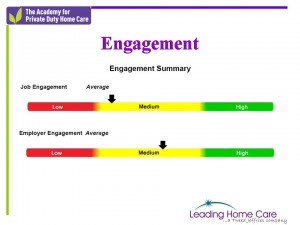
Having this information about caregiver engagement will be one more tool in your toolbox to help you recruit, select, train and retain high quality caregivers, office staff, and sales professionals.
There are four things you can learn about job candidates that will help you select the best:
- attitudes,
- behavior,
- cognitive ability,
- engagement.
By having this information about a candidate before the job interview, you will be able to ask behavioral interview questions that give you a clearer understanding of the person you are considering for the job. When you have this information in advance, and do a better job of interviewing, you are going to hire the very best candidates, and you will increase the performance of the caregivers, the satisfaction of your clients, and the profitability of your company.
A recent study conducted by Caregiver Quality Assurance using our Bad Hire Calculator shows that the typical cost of making a bad hire of a caregiver will be just over $1,500.00 if they quit or are terminated. What does it cost you if you made a bad hire, the caregiver is actively disengaged, but stays on the job?
What is your experience with job engagement?
What is the level of engagement of your employees? Are they actively engaged, not engaged, or actively disengaged?